The best men's leather wallet for you depends on three things: the leather grade, the wallet style that matches how many cards and how much cash you carry, and whether you need RFID blocking. Full grain leather lasts the longest and develops a patina, top grain offers a smoother finish with better stain resistance, and genuine leather is the most affordable but wears out fastest. This guide breaks down each factor so you can match a wallet to your actual daily carry, not just the style you like the look of.
Steel Horse Leather makes men's leather wallets from full grain leather, including bifold, front pocket, and coin purse styles. Below, we cover leather types, wallet construction, closures, sizing, and RFID technology, then walk through specific product recommendations.
Key Takeaways
- Full grain leather outlasts top grain and genuine leather and develops a visible patina; genuine leather is cheaper but typically shows wear within 1 to 3 years of daily use.
- Match your wallet type to your actual carry: 2-4 cards calls for a slim cardholder, 5-8 cards fits a bifold or trifold, and 10+ cards or a passport needs a long wallet or travel wallet.
- RFID blocking helps in high-traffic areas like airports and transit stations, but it works best alongside basic habits like front-pocket carry, not as a standalone fix.
- Magnetic closures can interfere with old-style magnetic strip cards, so check your card types before choosing that closure.
- A full grain leather wallet costs more upfront but typically lasts far longer than genuine leather, which often needs replacing within a few years.
What Is a Men's Leather Wallet?

A men's leather wallet is a small carry accessory made to hold credit cards, cash, and identification. It ranges from a two-card minimalist holder to a full-sized billfold with six or more card slots and a dedicated cash pocket.
The leather grade used, whether full grain, top grain, or genuine, determines how the wallet looks and holds up after months of pocket carry. Steel Horse Leather's wallet collection is built entirely from full grain leather for this reason.
What Types of Leather Are Used in Men's Wallets?
Wallets are typically made from genuine leather, top grain leather, full grain leather, vegan leather, or exotic leathers like shell cordovan. Each type differs in durability, cost, and how it ages with daily use. The tanning process and which layer of the hide is used both affect the final result (Hedberg et al., 2015; Sarkar et al., 2024).
| Leather Type | Durability | Patina Development | Typical Price Point |
|---|---|---|---|
| Genuine Leather | Lower; often shows wear in 1-3 years | Minimal, often coated to prevent aging | Budget |
| Top Grain Leather | Moderate to high; resists stains and moisture | Limited, smooth sanded finish | Mid-range |
| Full Grain Leather | High; can last decades with care | Rich, deepening patina over years of use | Mid to high |
| Vegan Leather | Lower to moderate; varies by manufacturer | None; does not age like animal hide | Budget to mid-range |
| Shell Cordovan / Palmellato | Very high; resists creasing and water | Distinctive, mirror-like finish over time | Premium |
Genuine Leather
Genuine leather is made from the lower layers of the hide, often finished with a surface coating that limits patina development (Hedberg et al., 2015; Laurenti et al., 2016). It is the most affordable wallet material and works fine for light, occasional use.
Genuine leather wallets, including many entry-level slim wallets and bifolds, typically do not age as gracefully as full grain or vegetable tanned options. If you want a wallet that lasts more than a few years, consider stepping up to a higher leather grade.
Top Grain Leather
Top grain leather is sanded or buffed to remove surface imperfections, giving it a smooth, uniform finish right out of the box. It resists moisture and staining better than full grain, which makes it practical for daily use in wet climates.
The trade-off is that top grain does not develop the same depth of patina as full grain leather over time (Hedberg et al., 2015). It remains a solid mid-range choice for card holder wallets, bifolds, and slim wallets.
Full Grain Leather
Full grain leather retains the outermost layer of the hide, including natural grain markings, and is considered the most durable wallet material available (Hedberg et al., 2015; Sarkar et al., 2024). It develops a visible patina over months and years of handling, darkening and softening with use.
Full grain vegetable tanned leather is produced using plant-based tannins instead of chromium, which is generally considered a more environmentally considerate production method (Hedberg et al., 2015; Laurenti et al., 2016). Full grain pull up leather, sometimes called crazy horse leather, is a specific variant that lightens when flexed and darkens again as it settles, creating a two-tone effect unique to each wallet. All Steel Horse Leather wallets are made from full grain leather for this reason.
Vegan Leather
Vegan leather is made from synthetic fibers or plant-based materials and offers an animal-free alternative for consumers who want a wallet-shaped accessory without animal hide. Read more in our guide on what vegan leather is made of.
Vegan leather wallets have improved in appearance in recent years, but they generally do not match the patina development or structural longevity of genuine animal hide leather (Laurenti et al., 2016). For buyers prioritizing ethics above longevity, it remains a legitimate option.
Exotic Leathers: Shell Cordovan and Palmellato
Shell cordovan is sourced from the fibrous flat muscle beneath a horse's hindquarters and is known for exceptional durability, water resistance, and a glossy, mirror-like surface. Unlike most leathers, it resists creasing, which is why it commands a higher price point among collectors (Hedberg et al., 2015; Laurenti et al., 2016).
Palmellato leather is a pebble-grain Italian leather known for its textured surface and refined feel (Hedberg et al., 2015). Both materials justify their price through longevity and a tactile quality that sets them apart from standard cowhide.
Is Vegetable Tanned Leather Better for the Environment?
Vegetable tanned leather is generally considered a more environmentally considerate option than chromium-tanned leather, though research shows mixed results depending on the environmental category measured (Laurenti et al., 2016; Faye and Ndiaye, 2021). Chromium tanning dominates global leather production, but concerns about chromium(VI) formation and waste runoff have pushed some buyers toward vegetable tanned alternatives (Laurenti et al., 2016; Halasz-Csiba, 2002; Sarkar et al., 2024).
Chromium release from leather depends on exposure conditions, surface area, temperature, and UV exposure (Hedberg et al., 2015; Halasz-Csiba, 2002). If sustainability matters to your purchase, look for brands affiliated with the Leather Working Group (LWG) or those that disclose their tanning process and supply chain (Hedberg et al., 2015; Faye and Ndiaye, 2021).
Vegetable tanned leather wallets need conditioning every few months, depending on use, to prevent cracking. Storing them away from direct heat and moisture extends both appearance and structural integrity over decades (Hedberg et al., 2015; Laurenti et al., 2016; Sarkar et al., 2024). For more on leather upkeep, see our guides on DIY leather conditioners and fixing scratched leather.
What Should You Look for in a Men's Leather Wallet?
A good men's leather wallet needs sturdy material, clean stitching, enough compartments for your cards and cash, and a closure style that fits your habits. Check the stitching closely before buying, since loose or uneven stitching is usually the first sign of a wallet that will fall apart within a year.
Material
Look for full grain or top grain leather that resists moisture and everyday dirt. Both hold up to daily wear far better than bonded or heavily coated genuine leather. A leather cleaner used every few months helps maintain the finish and prevents the surface from drying out.
Wallet Style
Your wallet style should match how you actually pay, not how you think you should carry things. If you use Apple Pay or Google Pay for most transactions and only carry one or two physical cards, a minimalist wallet or front pocket wallet is more practical than a full bifold.
If you carry 5 or more cards plus folded cash, a bifold or trifold gives you the compartments you need without forcing you to jam everything into one slot. Matching the wallet to your carry habits, rather than a style preference alone, is the most reliable way to pick a design that lasts (Hedberg et al., 2015; Haydon et al., 2020).
Color
Dark brown, tan, and black remain the most versatile wallet colors and pair with most leather belts and shoes. Full grain leather in natural or honey tones shows the most visible patina change over time, which is worth considering if you like watching a wallet age.
Price
A genuine leather wallet costs less upfront but usually needs replacing within a few years of daily use. A full grain leather wallet costs more initially but typically lasts many times longer, which often makes it the more economical choice over a 5 to 10 year period (Hedberg et al., 2015; Sarkar et al., 2024).
Exotic leathers like shell cordovan and Palmellato sit at the top of the price range, justified by their resistance to creasing and distinctive aging (Hedberg et al., 2015; Laurenti et al., 2016). Balance your budget against how long you actually want the wallet to last.
Hardware
Hardware, including magnetic clasps, snap closures, and metal accents, affects both durability and daily usability. Check that card slots hold cards snugly without stretching or loosening after a few months, since loose stitching around hardware is often the first point of failure.
How Do You Choose the Right Wallet Size?
Wallet size should be based on how many cards you carry, how much cash you keep on hand, and whether you carry your wallet in a pocket or a bag. The table below breaks down sizing recommendations by carry habit.
| Factor to Consider | What to Ask Yourself | Recommended Wallet Type | Pocket Fit |
|---|---|---|---|
| Number of cards carried daily | 2-4 cards, 5-8 cards, or 10+ cards? | 2-4: slim cardholder. 5-8: bifold or trifold. 10+: long wallet | Slim fits front pocket; long wallet needs a bag or coat pocket |
| Amount of cash carried | Little to no cash, or unfolded bills regularly? | Little cash: cardholder or money clip. Lots of cash: long wallet | Unfolded bills add bulk; folded cash stays slim |
| Extra items carried | Just cards and cash, or passport, coins, and travel documents? | Cards only: bifold. Extras: travel wallet or clutch style | Travel wallets need bag carry, not pocket carry |
| Pocket carry vs bag carry | Jeans pocket, or backpack and briefcase? | Pocket: slim or bifold. Bag: long wallet or travel bifold | Front pocket demands slim only; bag carry allows more size flexibility |
| Reliance on digital payments | Mostly Apple Pay and Google Pay, or heavy cash and card use? | Digital-heavy: ultra-slim cardholder. Cash and cards: bifold or long wallet | Digital-first users need the smallest wallet possible |
| RFID or smart tracking needs | Need RFID blocking, AirTag, or Chipolo tracking? | Yes: look for RFID lining and smart slots, common in long and travel wallets | Tech features usually add a small amount of bulk |
Take Your Measurements
Count the number of cards and the amount of cash you typically carry before shopping. If you carry 5 or more cards plus cash, a bifold or trifold with multiple slots serves you better than a minimalist cardholder. If you carry 2 to 4 cards and rely mostly on digital payments, a slim wallet or pop-up card wallet is usually enough (Hedberg et al., 2015; Haydon et al., 2020).
Get a Sense of the Style You Want
Compare bifold, trifold, cardholder, and travel wallet styles before committing. Each has different trade-offs between capacity and bulk, so weigh what you're willing to give up. Buy from an authorized retailer to make sure you're getting the leather grade you're paying for.
Consider Your Lifestyle
Think through how much cash and how many cards you carry, whether you travel often, and how much you use contactless payments. Frequent travelers may benefit from a travel wallet with RFID protection and an AirTag slot (Hedberg et al., 2015; Haydon et al., 2020; Orsi et al., 2019). If you prefer to travel light, a minimalist wallet with RFID blocking balances security and slim carry.
Compare Features
Look at the number of card slots, whether there's a dedicated cash pocket, and whether the wallet has RFID blocking or a magnetic closure. Bluetooth tracking via Chipolo and AirTag slots are increasingly common in higher-end wallets for users who want to locate a misplaced wallet (Haydon et al., 2020; Orsi et al., 2019). A smart card ejection system, found in some pop-up card wallets, lets you access a card with one hand.
Compare Dimensions
A wallet that's too large creates bulk in your pocket; one that's too small won't hold your essentials. Look for proportional card slots, water-resistant material, and a layout that keeps things organized without adding unnecessary thickness.
What Are the Different Wallet Closure Types?
Wallet closures come in four main types: buckle, snap, chain strap, and magnetic. Each has trade-offs in speed, security, and card compatibility (Li et al., 2017; Nguyen et al., 2022).
| Closure Type | Best For | Watch Out For |
|---|---|---|
| Buckle | Rugged, everyday wallets paired with full grain or pull up leather | Slightly slower access than snap or magnetic |
| Snap | Quick, simple access without straps or buckles | Snap mechanism can wear out after years of heavy use |
| Chain Strap | Casual, edgy aesthetic with added security against loss | Cumbersome if chain is lost or damaged |
| Magnetic | One-handed access, chip-based or contactless cards | Can interfere with older magnetic strip cards (Li et al., 2017; Nguyen et al., 2022) |
What Types of Men's Leather Wallets Are Available?
The main wallet types are bifold, trifold, front pocket, minimalist cardholder, card holder, case/pouch, specialty travel, RFID, and AirTag wallets. Each is built around a different combination of card capacity, cash storage, and portability.
Bifold Wallet
The bifold is the most common wallet style, folding once to create a slim profile with card slots and a cash pocket (Hedberg et al., 2015; Faye and Ndiaye, 2021). It fits comfortably in front or back pockets and balances capacity with a manageable thickness. The Pathfinder Bifold Wallet is Steel Horse Leather's version of this style.
Trifold Wallet
A trifold adds a second fold, creating extra card slots for people who carry more cards or documents. This extra capacity comes with more bulk, which matters if you carry your wallet in a front pocket (Hedberg et al., 2015; Faye and Ndiaye, 2021). Read more in our guide to men's long wallets.
Front Pocket Wallet
A front pocket wallet has a slim, flat profile built specifically for front-pocket carry, with a few card slots and a compact cash section. Many, including the Walden Front Pocket Wallet, include a money clip and RFID lining. See our full front pocket wallet guide for more options.
Minimalist Wallet and Cardholder
Minimalist wallets carry 2 to 5 cards and sometimes a slim cash pocket, designed for people who rely mostly on digital payments (Hedberg et al., 2015; Haydon et al., 2020). Many now include RFID blocking, and pop-up card wallets with a smart ejection mechanism let you access a card without fully opening the wallet.
Card Holder Wallet
A card holder wallet is built for multiple credit and debit cards with minimal or no cash storage. Materials range from genuine leather to full grain vegetable tanned leather, with higher-end versions offering RFID protection and reinforced stitching.
Case and Pouch Wallet
A case or pouch wallet, like the Cael Coin Purse, uses a zipper or snap closure to keep coins, cards, and small items together in one enclosed compartment. This style works well for anyone who wants everything zipped shut rather than tucked into open slots.
Specialty and Travel Wallets
Specialty and travel wallets add passport pockets, extra card slots, RFID protection, and sometimes AirTag or Chipolo tracking slots (Hedberg et al., 2015; Haydon et al., 2020; Orsi et al., 2019). Pair a travel wallet with a leather passport holder or check out our passport holder guide for frequent flyers.
RFID Wallet
An RFID wallet uses a shielded lining to block unauthorized radio frequency scans of your cards in crowded spaces (Hedberg et al., 2015; Haydon et al., 2020; Orsi et al., 2019). The actual risk of RFID skimming varies depending on location and card type, so RFID protection works best combined with habits like front-pocket carry rather than relied on alone (Hedberg et al., 2015; Haydon et al., 2020).
AirTag Wallet
An AirTag wallet has a dedicated slot for an Apple AirTag so you can track your wallet's location through the Find My network. Some models also support Chipolo tracking for broader device compatibility (Haydon et al., 2020; Orsi et al., 2019).
Bifold vs. Trifold: Which Should You Choose?
| Feature | Bifold Wallet | Trifold Wallet |
|---|---|---|
| Number of folds | One fold | Two folds |
| Typical card capacity | 4-8 cards | 8-12 cards |
| Pocket bulk | Slim, fits front or back pocket | Bulkier, better suited to back pocket or bag |
| Best for | Most everyday users | Users who carry extra cards, receipts, or documents |
Why Does RFID Blocking Matter in a Wallet?
RFID blocking matters most for people who carry multiple contactless cards through high-traffic environments like airports, subways, and busy retail areas (Hedberg et al., 2015; Haydon et al., 2020; Orsi et al., 2019). The lining disrupts radio frequency signals so a scanner can't read your chip-based cards without physical contact.
As contactless payment adoption grows, make sure the RFID lining in your wallet is actually certified rather than just marketed as "RFID safe" (Haydon et al., 2020; Orsi et al., 2019). Pairing RFID protection with front-pocket carry and a secure buckle or snap closure gives you the most complete defense against contactless theft.
If you mostly use Apple Pay or Google Pay, the need for RFID protection on physical cards is reduced but still worth having for the one or two cards you likely still carry as backup.
Our Top Picks for Men's Leather Wallets
Every wallet below is made from full grain leather and built for daily use. Explore the complete lineup in our leather wallets collection.
The Pathfinder Bifold Wallet

The Pathfinder Bifold Wallet is made from full grain crazy horse leather, known for its pull-up finish that lightens when flexed and darkens again over time. It has multiple card slots, a dedicated cash pocket, and a slim enough profile for front or back pocket carry. Customer reviews consistently mention the patina it develops after a few months of regular use.
The Walden Front Pocket Wallet

The Walden Front Pocket Wallet includes a money clip for cash and a front pocket layout that keeps cards organized without adding bulk. It works for both formal and casual occasions and comes in multiple color options. Reviewers most often mention its slim profile as the standout feature.
The Cael Coin Purse

The Cael Coin Purse is a zippered case built for coins, cards, and small personal items in one enclosed pouch. It's made from full grain leather with a secure zipper closure, making it a good standalone option or a companion piece to a minimalist wallet.
What Else Pairs Well With a Leather Wallet?
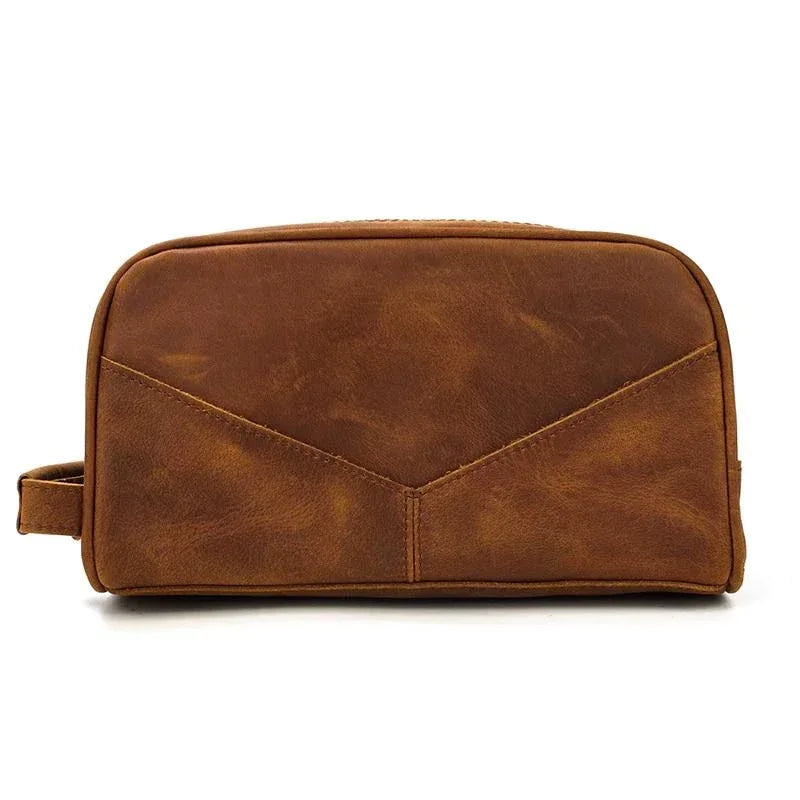
If you travel frequently, a wallet alone usually isn't enough. Consider pairing it with a Wanderer Toiletry Bag or Dado Leather Dopp Kit for grooming essentials, and a leather passport holder if you fly internationally often.
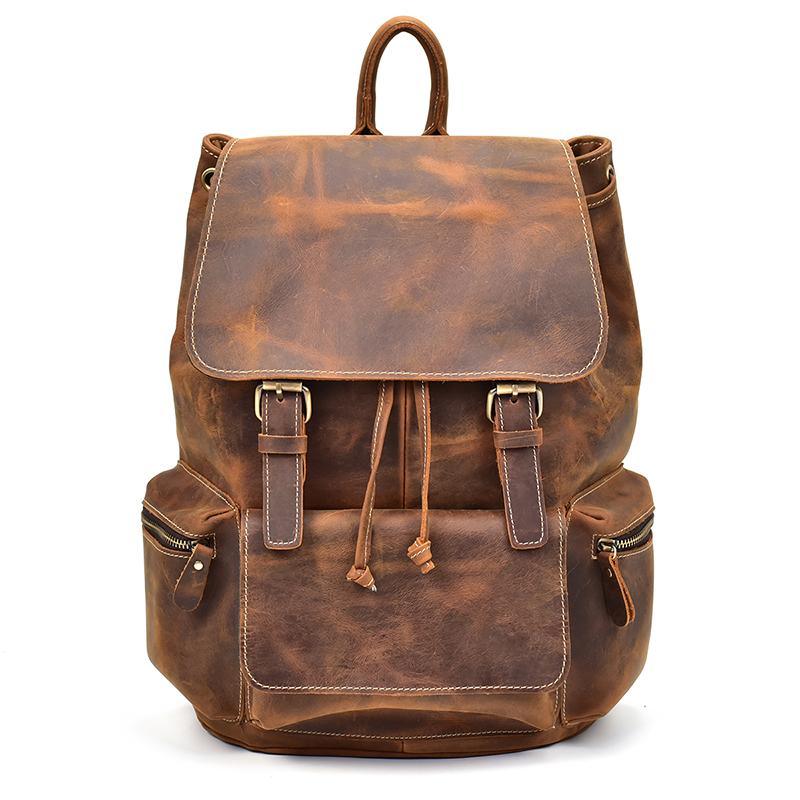
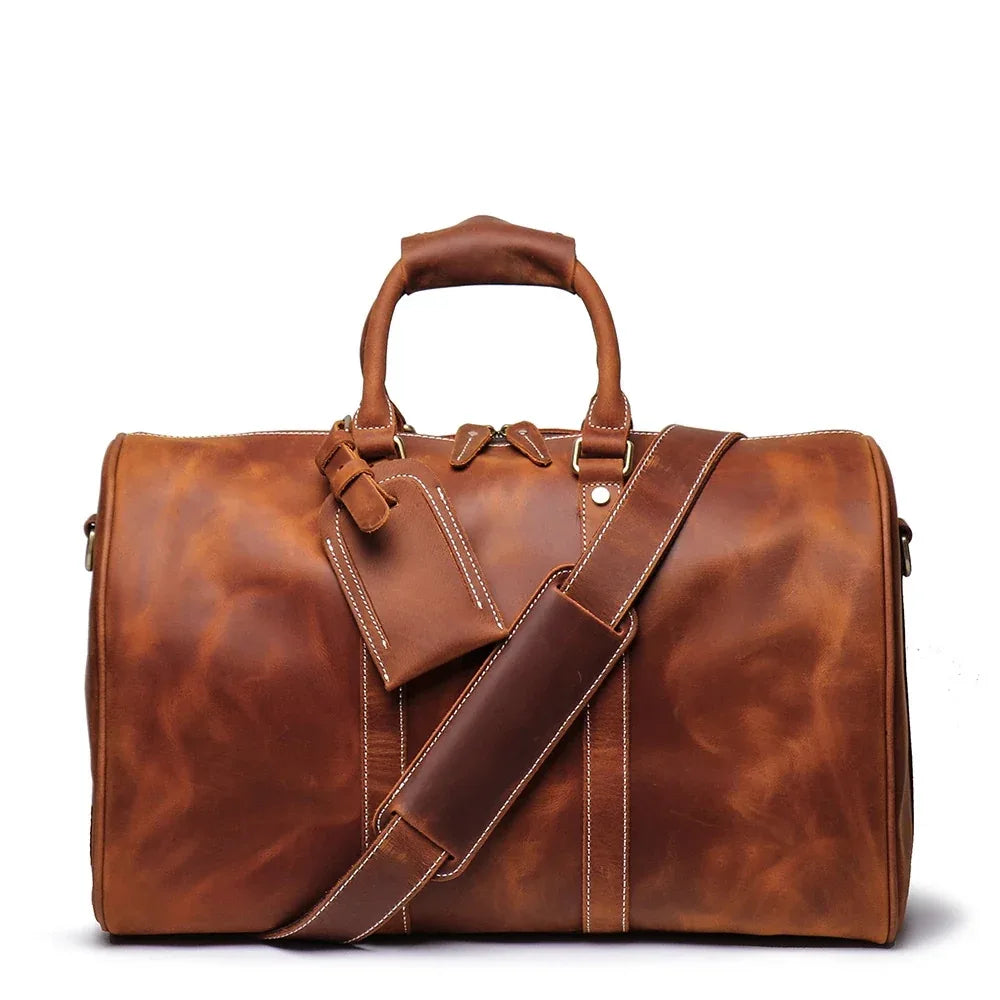
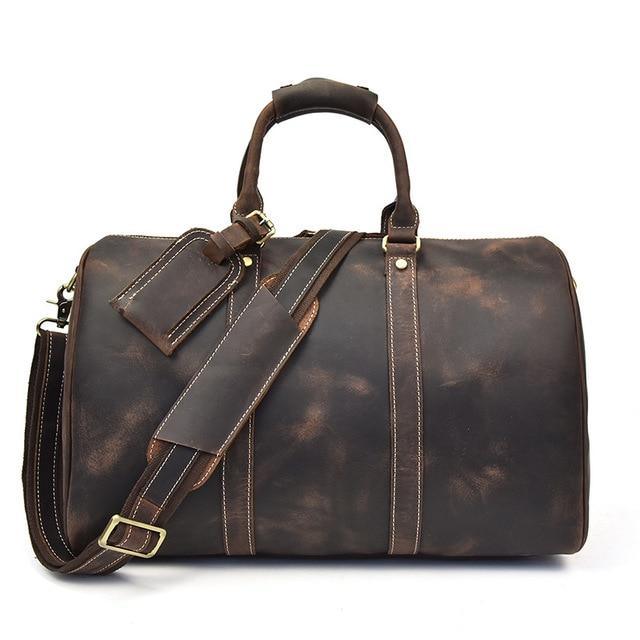
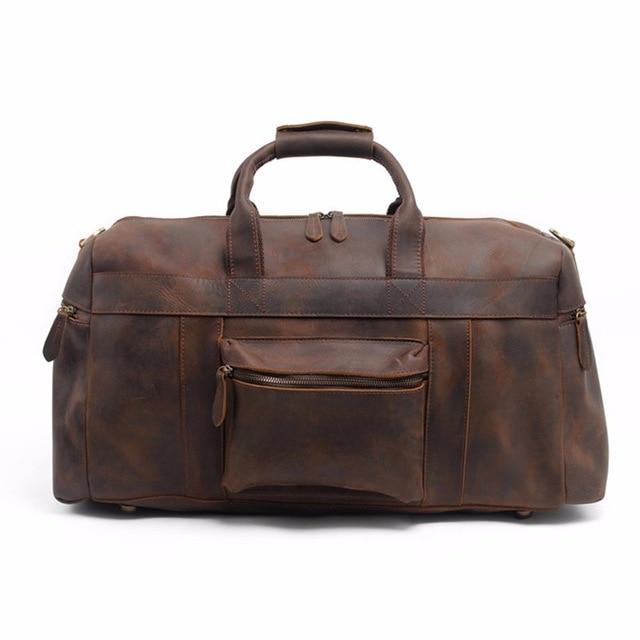
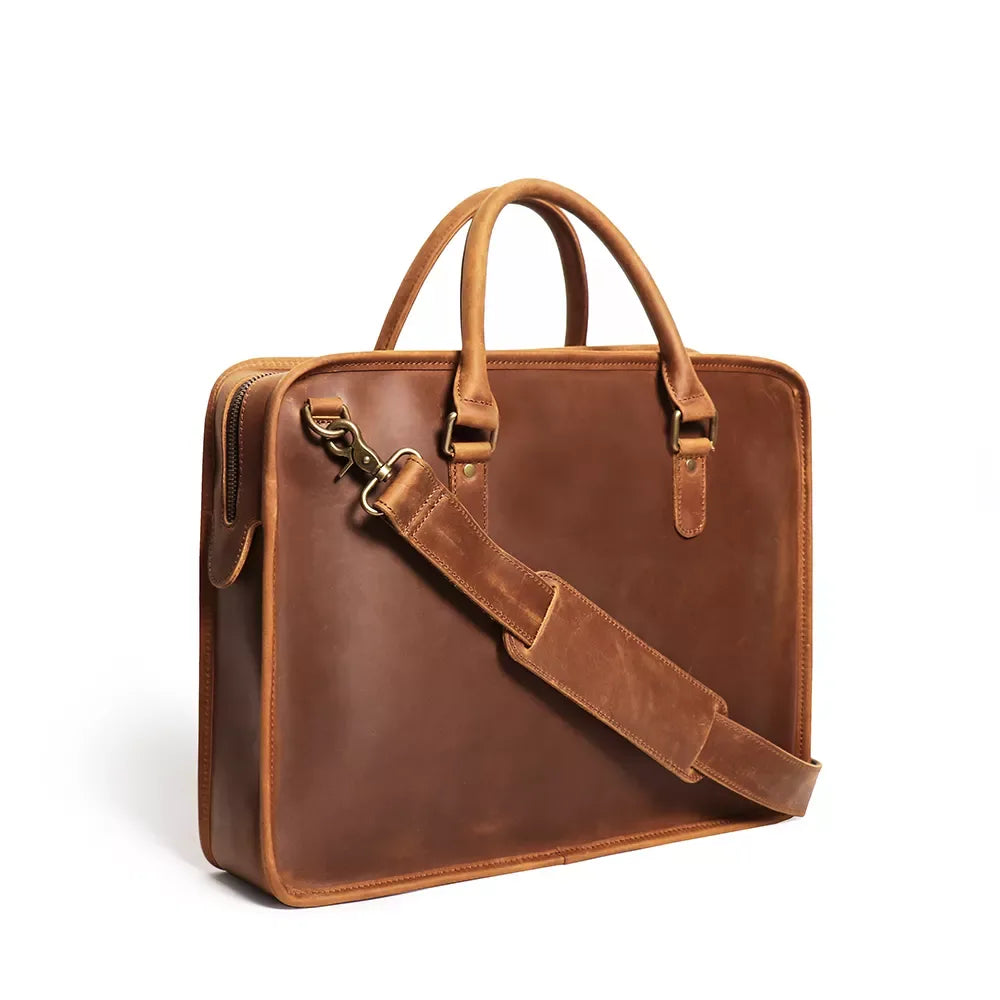
For daily carry beyond the wallet, our leather briefcases and leather laptop bags, including the Welch Briefcase and Hemming Leather Laptop Bag, are built from the same full grain leather as our wallets. If you're shopping for weekend travel, see our best leather duffle bags guide or browse the handmade leather duffel bag collection, including the Endre Weekender and Bjarke Weekender.
For gifting, our leather gifts for him guide and groomsman gift collection both include wallet pairings. Corporate buyers can find matching sets in our corporate gift ideas guide and corporate leather gifts collection.
Conclusion
Finding the right men's leather wallet comes down to matching leather grade, wallet style, and features to how you actually use a wallet day to day. Full grain leather wallets last the longest and develop character over time, while genuine leather works as a budget option for lighter use. Features like RFID blocking, AirTag slots, and magnetic closures add convenience but work best alongside good carry habits, not as a replacement for them.
Shop the full men's leather wallet collection at Steel Horse Leather, or browse our broader leather accessories collection for pieces that pair with your wallet.
References
Faye, C. and Ndiaye, M. (2021). Use of geospatial tools in morphometric analysis and prioritisation of sub-catchments of the Soungrougrou (Casamance Basin). Quaestiones Geographicae, 40(3), 65-84. https://doi.org/10.2478/quageo-2021-0024
Halasz-Csiba, E. (2002). Le Tan et le Temps. Techniques and Culture, (38). https://doi.org/10.4000/tc.1585
Haydon, P., Tobi, R., Bridge, G., Gurung, I., and Scott, C. (2020). Peas Please: Making a pledge for more veg. Nutrition Bulletin, 45(4), 483-494. https://doi.org/10.1111/nbu.12463
Hedberg, Y., Liden, C., and Wallinder, I. (2015). Chromium released from leather I: Exposure conditions that govern the release of chromium(III) and chromium(VI). Contact Dermatitis, 72(4), 206-215. https://doi.org/10.1111/cod.12329
Laurenti, R., Redwood, M., Puig, R., and Frostell, B. (2016). Measuring the environmental footprint of leather processing technologies. Journal of Industrial Ecology, 21(5), 1180-1187. https://doi.org/10.1111/jiec.12504
Li, J., Dodson, J., Yan, H., Zhang, D., Zhang, X., Xu, Q., and Zong, Y. (2017). Quantifying climatic variability in monsoonal northern China over the last 2200 years and its role in driving Chinese dynastic changes. Quaternary Science Reviews, 159, 35-46. https://doi.org/10.1016/j.quascirev.2017.01.009
Nguyen, J., Ferraro, C., Sands, S., and Luxton, S. (2022). Alternative protein consumption: A systematic review and future research directions. International Journal of Consumer Studies, 46(5), 1691-1717. https://doi.org/10.1111/ijcs.12797
Orsi, L., Voege, L., and Stranieri, S. (2019). Eating edible insects as sustainable food? Exploring the determinants of consumer acceptance in Germany. Food Research International, 125, 108573. https://doi.org/10.1016/j.foodres.2019.108573
Sarkar, J., Samanta, D., Chaudhuri, S., Angeline, J., Kumari, K., and Jaisankar, S. (2024). Harnessing leather waste in polymer matrix for sustainable smart shape-stable phase change materials. Journal of Applied Polymer Science, 141(29). https://doi.org/10.1002/app.55659
Frequently Asked Questions
What is the best type of leather for a men's wallet?
Full grain leather is generally the most durable choice for a men's wallet because it retains the outer hide layer and develops a patina rather than deteriorating with age (Hedberg et al., 2015; Sarkar et al., 2024). Full grain vegetable tanned leather adds an environmental consideration for buyers who care about tanning methods. Shell cordovan offers the highest durability and resistance to creasing but at a much higher price point.
How do I care for a men's leather wallet?
Store it away from moisture and direct heat, clean it periodically with a leather cleaner, and condition it every few months to prevent cracking (Hedberg et al., 2015; Laurenti et al., 2016). Full grain vegetable tanned leather in particular benefits from regular conditioning to preserve its appearance over decades. Avoid leaving it in direct sunlight, which fades color and dries out the material.
What is RFID blocking technology and do I need it?
RFID blocking uses a shielded lining to stop unauthorized radio frequency scanning of contactless cards in crowded places (Haydon et al., 2020; Orsi et al., 2019). It's worth having if you travel frequently or use public transit often, but it should be combined with front-pocket carry rather than relied on alone. The actual risk of RFID skimming varies by location and card type.
What is the difference between a bifold and trifold wallet?
A bifold folds once and holds 4 to 8 cards in a slim profile that fits front or back pockets (Hedberg et al., 2015; Faye and Ndiaye, 2021). A trifold folds twice and holds 8 to 12 cards but adds noticeably more bulk. Most people do better with a bifold unless they specifically need the extra storage. See our full wallet collection to compare both styles.
Is a magnetic closure wallet safe for my credit cards?
Magnetic closures are safe for chip-based and contactless cards but can interfere with older magnetic strip cards (Li et al., 2017; Nguyen et al., 2022). If most of your cards still use a magnetic strip, choose a buckle or snap closure instead. If your cards are chip-based or contactless, a magnetic closure poses minimal risk.
What is a smart wallet and is it worth buying?
A smart wallet combines leather construction with features like AirTag slots, Chipolo tracking, RFID blocking, or a smart card ejection system (Haydon et al., 2020; Orsi et al., 2019). It's worth the extra cost for travelers or anyone who wants to be able to locate a lost wallet. If you value both leather quality and modern convenience, it's a reasonable upgrade over a standard bifold.
How long does a full grain leather wallet last?
A well-made full grain leather wallet can last decades with proper care because the hide's fiber structure resists wear far better than genuine leather (Hedberg et al., 2015; Sarkar et al., 2024). Genuine leather, made from lower hide layers, tends to break down within 1 to 3 years of regular use. Regular conditioning and dry storage extend a full grain wallet's lifespan significantly.
Can I use a leather wallet if I mostly pay digitally?
Yes. A minimalist wallet or cardholder with 2 to 4 slots works well for people who use Apple Pay or Google Pay for most purchases but still need to carry a driver's license or a backup card (Hedberg et al., 2015; Haydon et al., 2020). Many current minimalist designs include RFID blocking, keeping the wallet slim and secure even with light daily use.
All of our bags at Steel Horse Leather are crafted from full-grain crazy horse leather, built to develop a rich patina over time. Browse our Leather Wallets.